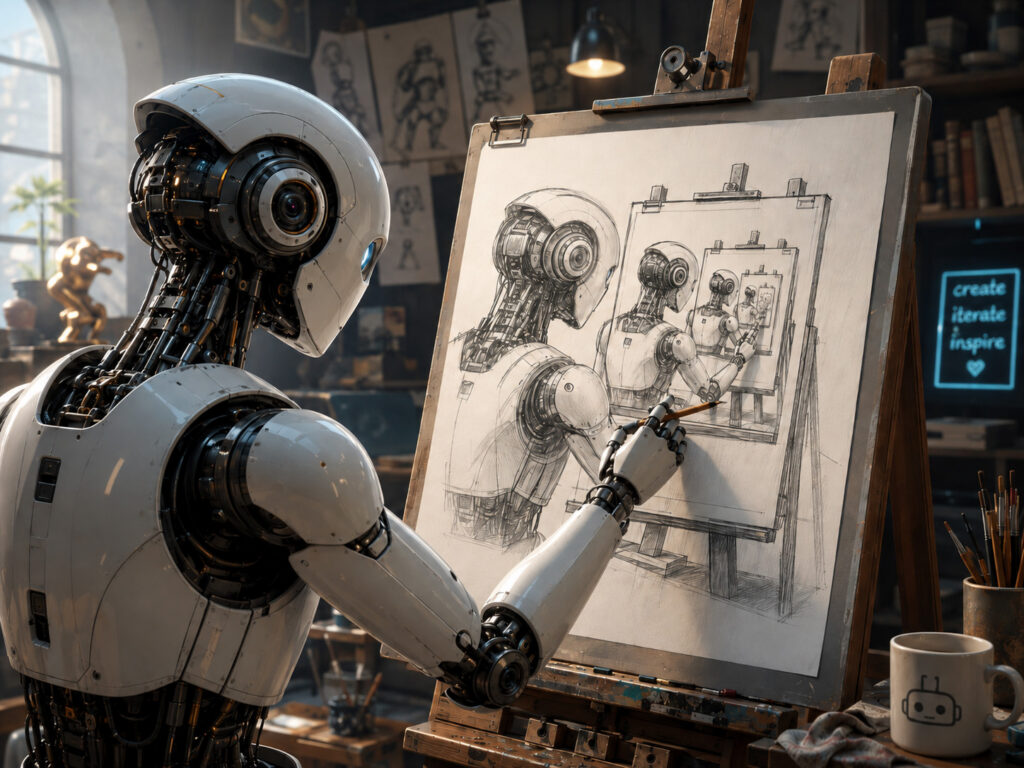
I have recently had a couple of people ask me about if/how I use artificial intelligence (AI) in my ministry, and what precautions I take. The short answer is that I use AI in several different areas, but with caution and checking. AI can provide a significant boost to productivity. It can also give wrong answers. Like more traditional software systems, the quality of the output is heavily dependent on the quality of the programming and the quality of the input. In the case of AI, the input consists of both training data and the prompts. I have seen significant improvements in AI models and outputs over the last year or two. Over all, I believe that like any technology, ancient or modern, it is basically good, but can be abused for evil. I do not fear AI or cars. A car can be used for great good (like helping me go to church, work, or a grocery store) or evil (like a bank robbery getaway car). Likewise, AI can be used for great good or for evil. Both need to be approached and used with caution, with an awareness of both benefits and potential dangers.
AI is used in many ways, but here are some ways that I use it as part of my ministry:
- Generating or editing illustrations and pictures.
- Drafting or checking computer software.
- Research.
- Natural language translation for user interfaces and correspondence.
- Bible translation assistance.
Generating Illustrations
AI image generation is all over the map. I find it useful for making illustrations for an article like this one. The lead illustration of this article took two prompt attempts to generate. It is art in the sense that the idea or premise came from me, a real human, but the AI filled in a lot of details. It also differs in many details from what I imagined. But it only took about 4 minutes to generate, including prompt writing and two generations of picture generation. For this purpose, it is good enough. It is harder to get good Bible passage illustrations out of an AI. Getting a consistent style that is acceptable to the target audience, Biblical accuracy, and getting details like fingers and faces right turns out to be challenging. There are several people working on that for large collections. I usually just do an isolated Bible illustration for a specific article, so it isn’t as hard. It still takes a lot of looking at the image to see what is inaccurate, then trying again. But it is still faster than working with pens, pencils, and brushes.
Drafting or Checking Computer Software
I have not yet had an AI generate software source code that was right on the first try, but usually the problems are easy for me to manually correct, or maybe direct the AI to correct. Often the AI will come up with an approach to a problem that I hadn’t yet considered. Over all, I think that a good AI is helpful in this area. It is also possible to use one AI to check another AI’s work.
Research
I use AI search engines, but I check the standard references for both reputation and content before taking the results at face value, just in case the AI is hallucinating or making up answers.
Translations for User Interfaces and Correspondence
AI is pretty good at translating the top 35 or so languages in the world, because there is so much training data available for those languges, and so much use and human feedback available. Those are the languages needed for web site user interfaces and correspondence. Since we develop web sites for use by people in every country in the world, this is useful. I also sometimes need to correspond with someone in a language I’m not fluent in. Even in a language I know, I sometimes check my understanding of what I read by running it through an AI translation.
Bible Translation Assistance
The standards of accuracy are MUCH higher for Bible translation than for any normal language translation work. Also, the greatest needs in Bible translation are in language groups that are so small than there is not a significant amount of training data for an AI. This means that you can’t just ask any of the usual AIs to translate the Holy Bible into one of the many minority languages that has no complete Bible translation and expect it to make sense out of it. Most AIs can’t even handle Melanesian Pidgin (Tok Pisin), a major trade language spoken in Papua New Guinea that actually has a reasonable corpus of written literature, let alone the language spoken by a small tribe with no written language. It just isn’t going to work. Also, even in the areas where AI is useful, we use it with caution because of the fear of God when dealing with His Word. That said, there are some ways that AI can help in the Bible translation process;
- Drafting new translations or revisions of the Holy Bible in one of the most-spoken languages. Those language groups already have Bible translations, but if a new translation is merited to compensate for language shift or to overcome copyright problems, then this is an option that is reasonable. I say “drafting” because the output needs to be checked for accuracy in all of the ways a Bible translation that was done initially by human translators should be checked.
- Drafting an Old Testament where a human-translated New Testament is done and checked. The New Testament can be used to train an AI well enough that it can create an initial draft of the Old Testament. That draft has to be checked by humans, of course, but it is a great head start. This works best where the Bible translation is more on the literal end of the translation philosophy scale.
- Back translation, or translating from the target language back into a language understood by a Bible translation consultant. This only works when there is enough already-checked training material in the translation to feed into an AI model. This is fairly low risk, since the main purpose is just for a consultant to find any areas that need to be looked at again and possibly corrected in the main translation.
Digging Deeper into AI in Ministry
There are other areas where AI is being used in ministry, but not by me. For a biblical and theological view of AI, I recommend my friend John Dyer’s posts on 9 Bible Verses on Artificial Intelligence and Generative Artificial Intelligence in Theological Education. See also the Wycliffe Global Alliance’s comments on AI.