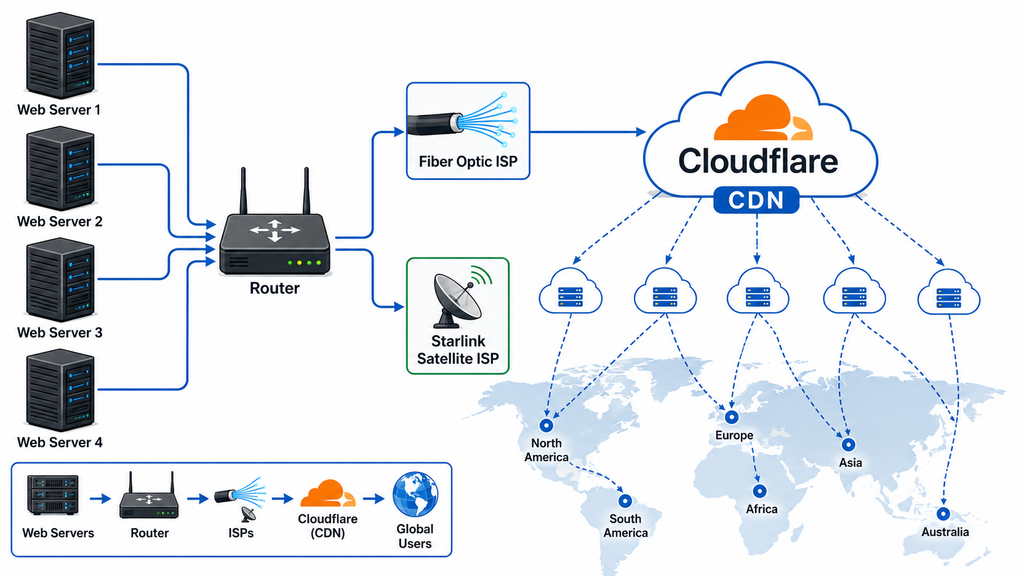
I host 16 web sites and one public ftp site. I used to host all of those on one or two leased dedicated servers in a data center over a thousand miles away. Because Hawaiian Telecom finally ran optical fiber all the way to my home office, it suddenly became more economical to run my own servers. I could even have a higher speed connection to the Internet than I had at the remote data centers. But there are challenges. I live on an island in the most remote island chain in the world. Sometimes tropical storms knock down trees and utility poles. Sometimes other things go wrong, and electrical power and/or Internet service goes out. Therefore, to do reliable web hosting, we need redundant sources of power and redundant Internet connections. Thanks to our awesome God and our partners, we have both.
For power, in addition to commercial power from Hawaiian Electric Company, we have solar power with battery backup. Heavy cloud cover comes with the same extreme weather that causes power outages, so we also have a portable propane-powered generator that can at least keep the computer equipment and our refrigerator running.
For Internet, our fastest and most economical available connection is the fiber optic connection. It works really well when it works, but sometimes it doesn’t. It has gone offline several times in the last few days as Hawaiian Telecom has been working on recovering from damage caused by Tropical Storm Lala. Therefore, we have a Starlink connection, as well. Our Starlink satellite connection has a faster upload speed than the fastest upload speed our old Spectrum cable Internet connection had. It is immune to local power grid outages, and needs no cables on utility poles. When the infamous fire storm destroyed much of Lahaina three years ago, the electric grid and all telephone service, including mobile phone service failed. Starlink worked, then and there. Even though it is not as fast as our fiber optic connection, it is much more reliable.
Unlike our fiber optic connection, which is usable for inbound IPv4 connections to a web server using dynamic DNS (DDNS), Starlink is not. Starlink uses carrier-grade network address translation (CGNAT), which makes inbound IPv4 connections not work. Unlike Hawaiian Telcom Fioptics, Starlink supports inbound IPv6 connections, which is great, but the majority of our target audience doesn’t yet support IPv6 (and probably won’t any time soon). Therefore to be able to use our Starlink connection to support web hosting, we either need to make it work with just outbound connections or pay Starlink a lot more for a much higher level of service. Since we need to be frugal with the ministry funds that people donate to our ministry, we opted for a combination of three cheaper options. One is to use Cloudflare’s free level of service, which allows us to make outbound tunnel connections from our local servers through either Internet service. Those connections then get relayed through Cloudflare servers close to where the requests come from. On average, this increases performance in two ways: (1) Cloudflare caching on their edge servers, and (2) it allows us to easily spread the load to more than one source server. Using multiple source servers not only lightens the load on each one, but it allows any of the servers to be restarted for security upgrades without any down time for the end users. This is what we use for 16 of our hosted web sites.
The second option we use is to create an outbound secure shell tunnel to an inexpensive leased virtual private server (VPS), and use that to relay HTTP and HTTPS requests to one of our source servers. We do this for four web sites that enable authorized Bible translators to edit data on that server.
The third option is one that we use only for our Crosswire Sword anonymous FTP site, and that is to just host it on the cheap VPS, because it is small enough and a light enough load to fit on that VPS. Anonymous FTP is an ancient (in computer terms) protocol that really needs to go away, but I keep this running to support some also-ancient open source Bible study software that is still in use. Revisions and new Bible study software should use the HTTPS repository with the same Bibles in it, because it has a much higher capacity, better security, and support in all current browsers.
In addition to the 3 ways of hosting using our two Internet connections, we actually have two more things that we do. Sometimes we host a development site directly on one of the local source servers using the Fioptics connection DDNS. This only works when Hawaiian Telcom is online. The other is to have a remote VPS server in hot standby mode, hosting all of the data for just our one biggest site, eBible.org. That VPS would strain under the load if it all went to it, but it could be used to keep the site online until a better performance solution could be made. That would be for disaster recovery in case my home and office were to be wiped out.
The last couple of days, my Eero router didn’t recognize an outage on Fioptics, because it was only partly failing, but failing enough that my web sites went down. This is not conducive to good sleep at night. Apparently, something was amiss with Hawaiian Telcom’s DNS servers, possibly combined with disconnections and reconnections associated with rebuilding their infrastructure after last week’s tropical storm. To overcome that problem, I did two things: set my Eero router to use alternate public DNS (Cloudflare’s 1.1.1.1 and Google’s 8.8.8.8) and set each of my source servers to connect to BOTH the main router via the fast wired network and to the Starlink network via WiFi. When the faster wired fiber network is working, that is used. When it is not, each server automatically falls back to use Starlink, even if the Eero router doesn’t recognize the failure and switch over. When the faster network comes back online, it automatically goes back to using that.
Sound complicated? It is. But the bottom line is that we are now getting quality Bible distribution from servers on an island in the middle of the Pacific ocean that offers some unique challenges, all on a missionary budget. Glory be to God!